The Practical Value of a Contemporary Cloud Icon Collection
In the digital landscape, visual communication is paramount. Symbols and icons act as a universal language, guiding users, clarifying concepts, and enhancing aesthetic appeal. For projects centered on modern technology, cloud services, or digital infrastructure, having a cohesive set of visual assets is crucial. A specialized Cloud System Icon Pack addresses this need directly, offering a curated toolkit for designers and content creators.
Core Characteristics of a Modern Icon Set
When evaluating a collection of icons for professional use, several technical and design characteristics stand out. The fundamental value lies not just in the number of icons, but in their versatility and adaptability.
Volume and Scope of Content
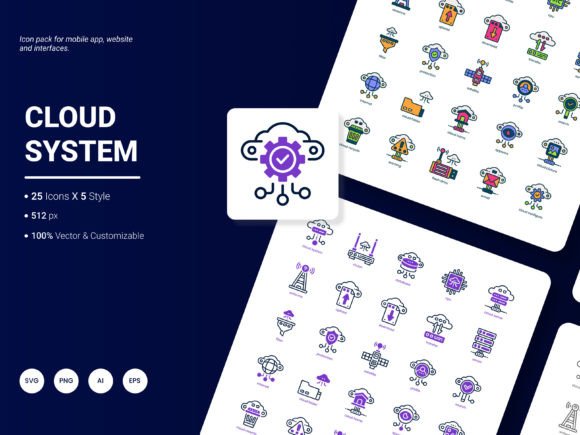
A pack comprising 25 individual icons represents a focused selection. This number is substantial enough to cover the most prevalent themes and services without being overwhelming. It typically includes representations for core cloud concepts like storage, computing, networking, security, and databases, alongside symbols for broader ideas like analytics, collaboration, and development. This scope ensures that for many projects, key visual needs are met without requiring supplementary assets from disparate sources.
Multiple File Formats for Maximum Compatibility
The availability of icons in six distinct formats—AI, EPS, SVG, PNG, PDF, and JPG—is a significant advantage. Each format serves a different purpose in the design and implementation workflow.
Vector formats like AI, EPS, and SVG are essential for design and scalability. They allow for infinite resizing without loss of quality and are easily edited within software like Adobe Illustrator or Figma. This is critical for tailoring icons to match a specific brand's color palette or style guidelines. Raster formats like PNG and JPG are the practical outputs for final implementation in environments where vector support is limited, such as certain content management systems or presentation software. PDF can be useful for documentation and print-ready materials. This multi-format approach removes technical barriers to usage.
Stylistic Consistency and Editability
A pack offering five distinct styles provides creative flexibility. These styles might range from outlined to filled, linear to glyph-based, or variations in weight and detail. This allows a designer to maintain visual consistency across an entire project while applying icons in different contexts—a minimalist style for a mobile app interface, perhaps, and a more detailed version for a printed report. The inherent editability of the vector files means these styles are not fixed; elements can be modified, colors changed, and components rearranged to create entirely new derivatives if needed.
Primary Applications and User Groups
The utility of such an icon pack extends across numerous fields and professions. Its relevance is defined by the universal need to explain and represent cloud-centric ideas.
Digital Interface Design
For web designers and UI/UX specialists, these icons are integral components. They can be used in navigation menus, feature lists, dashboard widgets, and onboarding screens. A clear icon representing "data sync" or "API gateway" enhances user understanding far more effectively than text alone. The trendy and fresh design ensures the interface feels current and aligned with modern design sensibilities.
Communication and Presentation Materials
Business professionals, educators, and marketers frequently need to explain cloud systems. In slide decks, white papers, analytical reports, and infographics, high-quality icons serve as visual anchors. They break down complex architectures into digestible components and make technical presentations more engaging. The ability to export in PDF or high-resolution PNG is particularly valuable here.
Template and Prototype Development
Creators building website templates or application prototypes for sale or rapid deployment benefit immensely from included icon sets. Having a ready-made, stylistically coherent pack like this accelerates the design process and ensures a polished final product. It adds value to the template without requiring the end-user to search for additional assets.
The Broad Audience
From hobbyists building personal project websites to researchers illustrating their findings on cloud adoption trends, and from entrepreneurs pitching a tech startup to corporate teams documenting IT infrastructure, the user base is diverse. The common thread is a requirement for professional, clear, and adaptable visuals that communicate specific technological concepts without requiring custom illustration work.
Integration and Workflow Considerations
Implementing an icon pack into a project involves practical steps. The flexibility mentioned earlier directly translates to smoother workflows.
Starting with the vector source files (AI/EPS/SVG), a designer can integrate the icons into their master design file. They can unify colors to match the project's palette, adjust stroke widths for consistency with other design elements, or even combine icons to create new, compound symbols. Once the design is finalized, appropriate formats are exported for implementation—SVG for modern web development to maintain crispness at any size, PNG for specific fixed-size applications, or JPG for certain background elements.
The process underscores a move away from static, inflexible assets. An editable, multi-format pack is a dynamic resource that adapts to the project's needs rather than forcing the project to adapt to the limitations of the icons.
Evaluating the Long-Term Utility
Beyond the immediate project, the characteristics of such a pack offer lasting value. The trendy design ensures it remains relevant for the foreseeable design cycle. The coverage of popular content means it addresses current market terminology and services. Furthermore, the fact that it is built for easy editing means it can evolve. As cloud services change and new concepts emerge, designers can subtly modify existing icons or use them as a base to create new ones, maintaining a consistent visual language over time.
For teams and individuals looking to establish or maintain a professional visual identity around technology topics, a dedicated, high-quality icon collection is more than just a set of pictures. It is a foundational design resource that enhances clarity, speeds up production, and elevates the overall quality of communication. The emphasis on practical formats, stylistic options, and core content relevance makes it a tool suited for real-world application across many scenarios.
As the digital ecosystem grows, so too does the need for precise visual tools. Feedback on such resources is often valuable for their ongoing development. Creators are frequently interested in user suggestions regarding services, concepts, or styles that could be included in future updates to ensure the pack continues to meet evolving needs.