The Alchemy of Modern Communication: Chemistry Icons as a Universal Design Catalyst
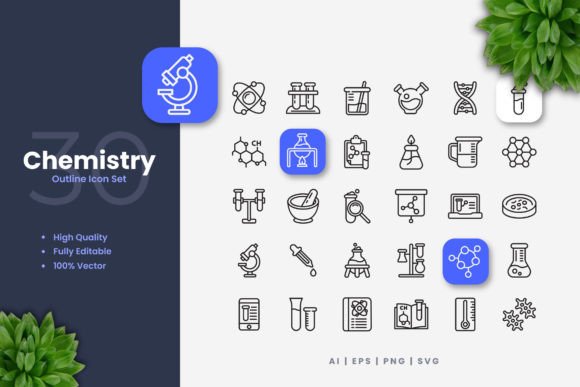
In the digital and physical landscapes where ideas compete for attention, clarity and symbolism are paramount. Enter Chemistry Icons, a meticulously crafted collection that transcends the literal laboratory to become a versatile language for modern communication. This set of 100 simple and clean vector icons isn't merely about atoms and molecules; it's a design system built to catalyze understanding across websites, mobile apps, publications, and marketing materials. By distilling complex scientific concepts into elegant visual shorthand, these icons serve a growing need for intelligent, adaptable graphic elements in a world driven by information.
Beyond the Beaker: Icons in the Age of Visual Efficiency
The demand for Chemistry Icons reflects a broader shift in how professionals and creators operate. We live in an era of visual saturation, where users parse information quickly and aesthetics directly influence credibility. A generic or poorly designed graphic can undermine a message, while a cohesive, professional set enhances it. This collection fits seamlessly into trends favoring minimalism, systematic design, and cross-platform consistency. Whether for an ed-tech startup's app interface, a pharmaceutical company's internal report, a science blogger's social media post, or a university's recruitment banner, these icons provide a common visual thread. They bridge the gap between specialist knowledge and public understanding, making abstract concepts tangible.
This relevance is amplified by changing workflows. Today's creator—be it a marketer, freelancer, or entrepreneur—often juggles multiple outputs from a single project. A campaign might require a website update, an Instagram carousel, a printed flyer, and a conference poster. The fully customizable nature of Chemistry Icons, with editable stroke weight and color, means one asset can be adapted infinitely without losing its core identity. This aligns perfectly with the expectation for agile and efficient content creation, where time spent sourcing disparate graphics is time lost.
The Core Reaction: Why Customizable Vector Design Matters
Attention is paid to Chemistry Icons because they solve a practical problem with technical precision. The promise of "100 Vector" and "100 Customizable" icons is significant. Vector graphics are the industry standard for professional design because they are resolution-independent—they scale from a mobile screen to a billboard without pixelation or quality loss. The included source files (.AI, EPS 10, SVG) are not just deliverables; they are licenses to innovate within industry-standard software like Adobe Illustrator and CorelDRAW.
Consider a practical example: a health-tech company designing a patient education portal. Using the PNG files with transparency, they can quickly prototype a web page. For the final brand integration, their designer opens the SVG file, changes the icon color to match the corporate palette, adjusts the stroke weight to better complement the font choice, and exports optimized assets for both web and print. The "Easy Drag and Drop" capability accelerates initial mock-ups, while the deep editing potential ensures final outputs are perfectly branded. This workflow meets the modern preference for tools that are simple to start with but powerful to finish with.
Connecting to Larger Developments: The Synthesis of Science and Design
The rise of specialized icon sets like Chemistry Icons is part of a larger development: the professionalization of niche communication. As sectors like biotechnology, renewable energy, chemistry education, and wellness become more prominent in public discourse, their visual representation needs to evolve. No longer is it sufficient to use a clip-art flask for all science-related content. Audiences, from investors to consumers, are more discerning. They expect visual cues that are specific and accurate—a distinct icon for a "molecule" versus a "reaction," for a "microscope" versus a "petri dish." This collection provides that specificity, enabling creators to build more nuanced and authoritative narratives.
Furthermore, it connects to the technology trend of design systems. Large organizations and even individual creators are building reusable component libraries to maintain consistency and speed. Chemistry Icons can serve as the foundational visual asset layer for any project related to science, education, or innovation. By being fully editable, they integrate into these systems, allowing teams to establish rules—like a specific color for "warning" icons or a standardized size for app navigation—that scale across all touchpoints.
Practical Applications: From Infographics to Brand Identity
The utility of these icons is best understood through observation. An environmental nonprofit creating an infographic about carbon capture can use the molecular and equipment icons to visualize processes clearly, making dense science accessible. A freelance graphic designer working on a textbook cover can employ the clean icon style to convey the subject matter (Chemistry) without clutter, appealing to a modern aesthetic. An entrepreneur launching a craft beer brand (a process deeply rooted in chemistry) might adapt the icons for unique labeling, connecting their product to a tradition of precision and craft.
Each format included—from the production-ready vector files to the web-friendly PNGs—serves a distinct phase in the creative process. The Readme.txt file underscores a commitment to usability, guiding users of all skill levels. This practical bundling addresses the real-world scenario where a team might include a developer needing SVG, a marketer needing PNG for social media, and a print designer needing EPS for a brochure. Chemistry Icons delivers to all stakeholders.
Conclusion: A Stable Compound for Unstable Media Requirements
Ultimately, Chemistry Icons represents more than a product; it represents a solution for the volatile requirements of contemporary media. The needs are changing: audiences expect better visual storytelling, businesses demand brand consistency across more channels, and creators require tools that don't limit their adaptability. This icon set, through its high-quality design and profound customization capabilities, meets these needs head-on. It empowers professionals, marketers, and enthusiasts to communicate complex, chemistry-related ideas with simplicity and style, ensuring that their message is not just seen, but understood and remembered. In the alchemy of turning information into impact, these icons are a fundamental catalyst.